The science
What we know, what we don't, and how we tell them apart.
Desert truffle is a promising ingredient with a long history of use and a growing body of laboratory research. It is not a proven treatment for macular degeneration, and this page will not pretend otherwise. Here is every claim we make, with its evidence level attached.
The AREDS trials, stated accurately
Supplement marketing routinely blurs these two trials together. They are different studies, run in different decades, with different results — and the difference matters if you are deciding what to take.
| AREDS | AREDS2 | |
|---|---|---|
| Ran | 1992–2001 | 2006–2012 |
| Published | 2001 | 2013 |
| Participants | 3,640 | 4,203 |
| Key finding | Antioxidants plus zinc reduced the risk of progression to advanced AMD by about 25% at five years in participants at high risk | Adding lutein and zeaxanthin produced no statistically significant reduction overall; a ~25% reduction appeared only in the subgroup with the lowest dietary lutein and zeaxanthin intake |
| Formula change | Included beta-carotene | Beta-carotene replaced with lutein and zeaxanthin |
TruVista Desert Truffle Plus AREDS2 contains the AREDS2 nutrient set at the doses used in that trial. It does not contain beta-carotene.
The five pathways, one at a time
1. Macular carotenoids
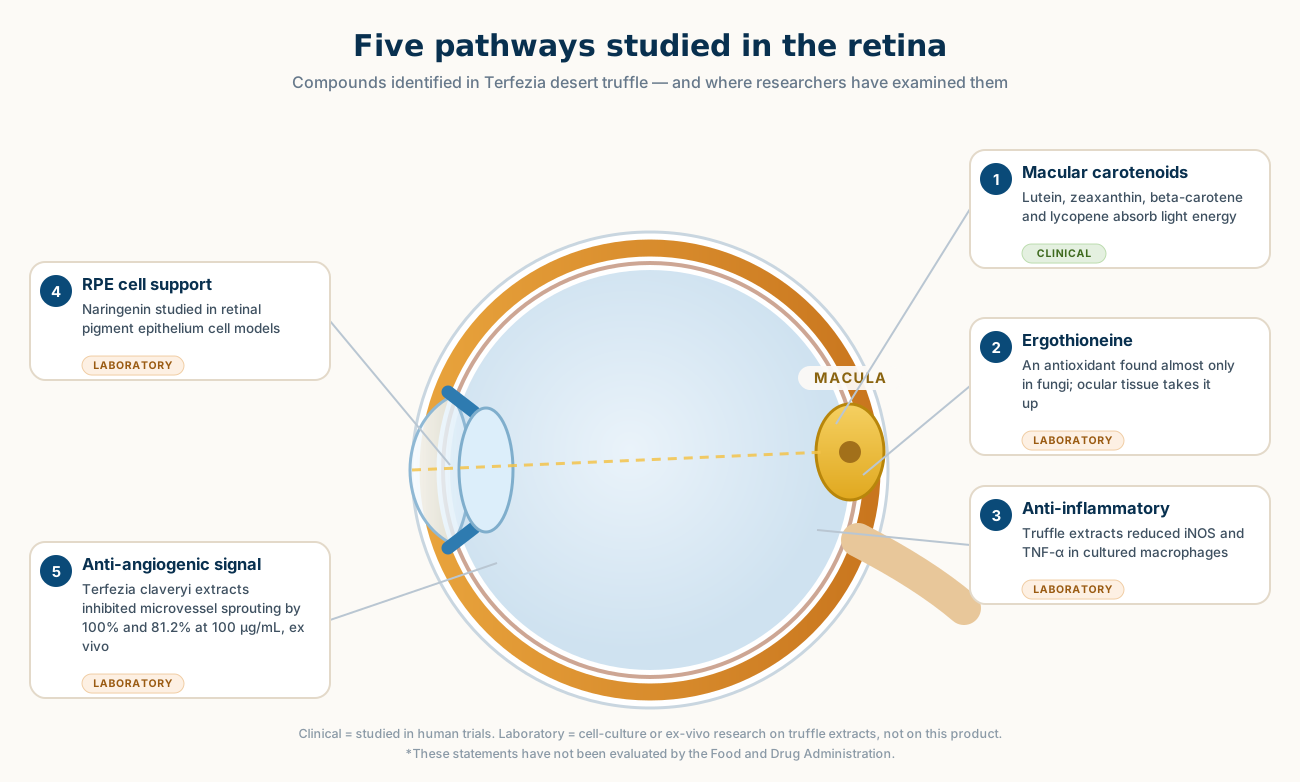
Lutein and zeaxanthin are concentrated in the macula, where they absorb short-wavelength light and act as antioxidants. Both were studied in AREDS2 and both are in this formula at the trial doses. Desert truffle additionally contains beta-carotene, lycopene and anthocyanins.
Correction: an earlier version of this site said macular pigment filters “up to 90%” of blue light. We could not substantiate that figure and have removed it. Published estimates of macular pigment blue-light attenuation are considerably lower.
2. Ergothioneine
Ergothioneine is an unusually stable antioxidant found almost exclusively in fungi. The body has a dedicated transporter for it (OCTN1) and concentrates it in several tissues including the eye — which suggests it has a role there, though what that role is remains under study.
There is no human trial showing that supplemental ergothioneine benefits macular health.
3. Anti-inflammatory activity
In cultured mouse macrophages stimulated with LPS and interferon-gamma, Terfezia extracts reduced markers of inflammation. In that study T. boudieri reduced nitric oxide, iNOS, COX-2, TNF-α and IL-6; T. claveryi — the species in this product — showed comparable effects except that no significant effect on IL-6 or COX-2 was seen at protein level.
We state the species-specific result because it is what the paper actually reports. This is cell-culture work, not a study in people.
4. Retinal pigment epithelium support
The retinal pigment epithelium is the cell layer beneath the photoreceptors that clears waste and recycles visual pigments. Naringenin, a flavonoid present in desert truffle, has been examined in retinal cell models under oxidative stress.
Cell-model research. No human outcome data.
5. Anti-angiogenic signal
In an ex-vivo aortic ring assay, hexane and ethyl acetate extracts of Terfezia claveryi inhibited microvessel sprouting by 100% and 81.2% respectively at 100 µg/mL. Separately, T. boudieri extracts have shown suppression of VEGF expression.
These are isolated-tissue and cell experiments using solvent extracts at defined concentrations. They do not demonstrate an effect in the human eye, and they are not a claim about wet AMD.
References
Every citation below has been checked against PubMed. Where the previous version of this site cited a PMID that resolved to a different paper, it has been corrected or removed.
- Dahham SS, Al-Rawi SS, Ibrahim AH, Abdul Majid AS, Abdul Majid AMS. Antioxidant, anticancer, apoptosis properties and chemical composition of black truffle. Saudi J Biol Sci. 2018;25(8):1524–1534. doi:10.1016/j.sjbs.2016.01.031 · PMID 30591773
- Dawood AS, Sedeek MS, Farag MA, Abdelnaser A. Terfezia boudieri and Terfezia claveryi inhibit the LPS/IFN-γ-mediated inflammation in RAW 264.7 macrophages through an Nrf2-independent mechanism. Sci Rep. 2023;13(1):10106. doi:10.1038/s41598-023-35612-8 · PMID 37344506
- Al Obaydi MF, Hamed WM, Al Kury LT, Talib WH. Terfezia boudieri: a desert truffle with anticancer and immunomodulatory activities. Front Nutr. 2020;7:38. doi:10.3389/fnut.2020.00038 · PMID 32322585
- Tejedor-Calvo E, Amara K, Reis FS, et al. Chemical composition and evaluation of antioxidant, antimicrobial and antiproliferative activities of Tuber and Terfezia truffles. Food Res Int. 2021;140:110071. doi:10.1016/j.foodres.2020.110071 · PMID 33648293
- Baldelli S, Aiello G, De Bruno A, et al. Bioactive compounds and antioxidant potential of truffles: a comprehensive review. Antioxidants (Basel). 2025;14(11):1341. doi:10.3390/antiox14111341 · PMID 41300498
- Lee H, Nam K, Zahra Z, Farooqi MQU. Potentials of truffles in nutritional and medicinal applications: a review. Fungal Biol Biotechnol. 2020;7:9. doi:10.1186/s40694-020-00097-x · PMID 32566240
- Bryl A, Falkowski M, Zorena K, Mrugacz M. The role of resveratrol in eye diseases — a review of the literature. Nutrients. 2022;14(14):2974. doi:10.3390/nu14142974 · PMID 35889930
- Cheah IK, Halliwell B. Ergothioneine, recent developments. Redox Biol. 2021;42:101868. doi:10.1016/j.redox.2021.101868
Read the label. Ask your doctor. Then decide.
We would rather you check us than take our word for it.
See the product & full ingredient list